
MCWH is calling for sustained investment in the health, safety and leadership of migrant and refugee women in the 2026-27 Federal Budget.
Women and girls born in non-English speaking countries make up a significant portion of Australia's population, yet they face substantial barriers in accessing safety and equity. Discrimination and workplace exploitation remain prevalent, and migrant women are disproportionately affected by gendered violence and workplace sexual harassment. Despite recent governmental strides in gender equality, migrant and refugee women continue to experience significant inequities.
MCWH, a national organisation led by and for migrant and refugee women, provides tailored, in-language programs that address these issues. With sustained funding, MCWH can continue to prevent violence against women, promote gender equality, and ensure the participation of migrant and refugee women in Australia’s workforce and communities.
In our budget bid, we propose five key areas for investment to ensure that migrant and refugee women are not left behind as Australia moves toward a more inclusive, gender-equitable future:
1. Improving health equity through in-language health education
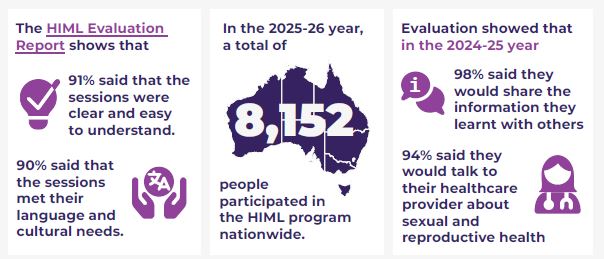
For migrant and refugee communities, access to in-language and culturally tailored health information can change lives. Health in My Language (HIML), a national initiative led by Multicultural Centre for Women’s Health (MCWH) in partnership around Australia, is a clear example of this.
How do we know Health in My Language works?
In 2026-27 MCWH calls upon the Australian Government to:
Provide sustainable, multi-year funding to Health in my Language.
Option 1: $21,600,000 (lapsed funding amount)
Continue to deliver HIML in each state and territory, with the same breadth of topics and a reduced reach in each jurisdiction.
Silver option 2: $26,127,400
Continue to deliver HIML in each state and territory, with the same breadth of topics and the same reach in each jurisdiction. In addition, investigate and develop options to formalise and extend the national Bilingual Health Educator workforce.
Gold option 3: $30,981,000
Continue to deliver HIML in each state and territory, with an increased breadth of topics and increased reach in each jurisdiction, including migrant and refugee men, PALM scheme workers, young women, international students, and more newly arrived communities. In addition, investigate and develop options to formalise and extend the national Bilingual Health Educator workforce.
Read more about Health in My Language
2. Promoting migrant and refugee women’s health through evidence based research and policy
Migrant and refugee women in Australia have poorer health outcomes, and lower levels of access to health services than the general population. Research shows that migration is a key determinant of health, and migrant and refugee women in particular are more vulnerable to health deterioration because of gender-specific barriers and challenges.
To address this health inequity, we need to better understand the specific barriers to healthcare impacting on migrant and refugee women, and how to systemically improve health outcomes. A better understanding will be achieved by bringing together migrant and refugee women’s concerns, service sector and policy knowledge with the latest research, and translating the available evidence into tangible program, service and policy development.
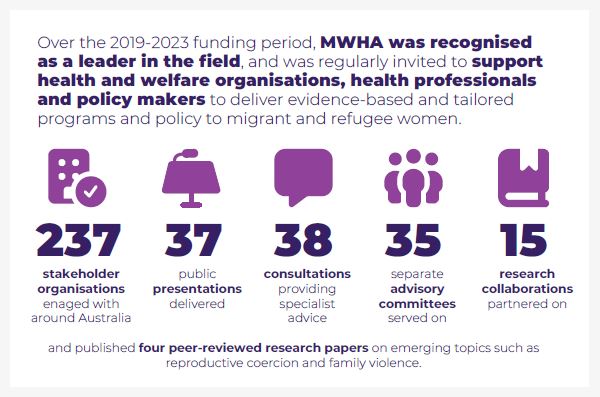
The Multicultural Women’s Health Australia (MWHA) program, which operated across Australia until 2023, did just that.
How do we know MWHA works?
In 2026-27 MCWH calls upon the Australian Government to:
Provide ongoing, sustainable multiyear funding to MCWH for the continuation of the MWHA program.
Over 4 years $2,800,000.
Read more about MWHA
3. Leading national capacity building efforts to prevent gendered violence
While the Albanese Government has made significant strides in gender equality, primary prevention and response, MCWH’s proposed targeted investment seeks to ensure that migrant and refugee women and their communities do not get left behind.
More investment must be made into community-led programs that build awareness about domestic, family and sexual violence and facilitate earlier access to the system, including tailored, in-language, community-based, outreach programs.
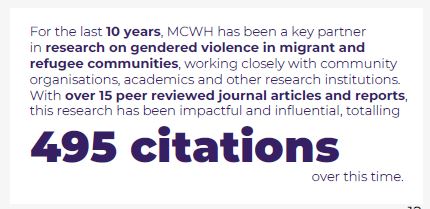
MCWH is uniquely placed to lead national capacity building efforts, having robust theoretical expertise, practice experience and sustained relationships with migrant organisations, women and communities fostered through over 45 years of experience working in women’s health and the multicultural sector.
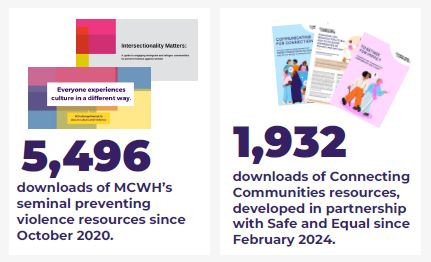
How do we know MCWH’s capacity building works?
In 2026-27 MCWH calls upon the Australian Government to:
Provide ongoing funding to MCWH to:
- extend its specialist capacity building role nationally to facilitate consistency, reduction of duplication, and the sharing of practice wisdom, among key stakeholders, including multicultural organisations and communities delivering gendered domestic, family and sexual violence prevention programs and activity.
- engage men and boys from multicultural communities in a specific program to prevent gendered violence, and develop a national guide for the multicultural sector, the domestic, family and sexual violence sector and multicultural communities.
- deliver in-language education about gendered violence, including domestic, family and sexual violence, and workplace sexual harassment across Australia, utilising the existing infrastructure of the national Health in my Language program.
Over 4 years $2,170,300.
Read about MCWH's gendered violence prevention capacity building
4. National FGM/C prevention and support
According to the most recent estimate in 2019, there are approximately 53,000 women and girls living in Australia who have undergone FGM/C.17 Since 1998, MCWH has been working with communities affected by Female Genital Mutilation/Cutting (FGM/C). In 2013, that work extended to a national level, collaborating with community advocates and health professionals and
services to prevent and address FGM/C in Australia through two the delivery of two key projects.
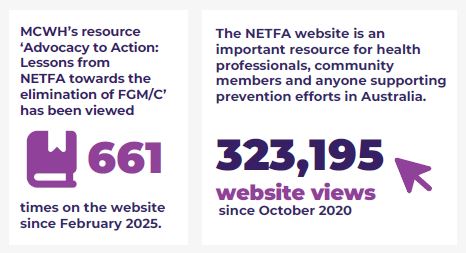
The National Education Toolkit for FGM/C Awareness (NETFA), funded by the Commonwealth Government from 2013 to 2025, was developed by MCWH to provide a community voice for women affected by FGM/C. The NETFA program built the capacity, skills and confidence ofwomen with lived experience of FGM/C to advocate and take leadership in their communities
and in health systems to prevent and address FGM/C in Australia.
The SWIFT Project: Supporting Workers in FGM/C Training supports health workers across Australia to effectively prevent and respond to FGM/C through culturally responsive, trauma-informed training, practical resources, and a national Community of Practice.
How do we know SWIFT/NETFA works?
In 2026-27 MCWH calls upon the Australian Government to:
Provide ongoing funding to MCWH to continue to work with communities and health practitioners to prevent and address FGM/C in Australia by:
- delivering the SWIFT Community of Practice and online Network of health professionals;
- co-designing and developing evidence-based resources for health professionals and communities;
- addressing key issues relevant to lived experience of FGM/C, including stigma, mental health, sexual health and sexuality;
- supporting community-led advocacy by women with lived experience through delivery of the NETFA leadership program
- updating national data collection and research to enable more targeted and effective service planning across Australia.
Over 4 years $2,047,400.
Read about NETFA/SWIFT
5. PACE Grassroots Gender Equality Leadership Program
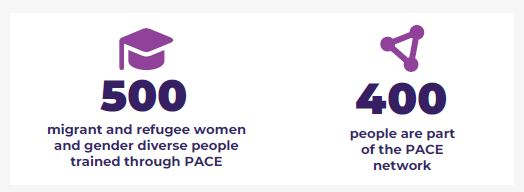
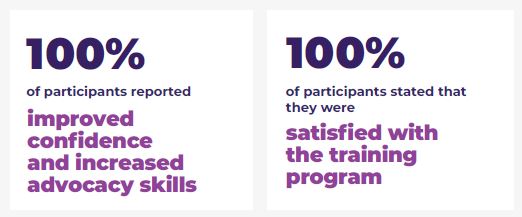
The PACE Leadership program is an evidence-based, grassroots, inclusive, community-led initiative developed by MCWH in 2009. PACE, which stands for Participate, Advocate, Communicate and Engage, strengthens the way migrant and refugee women and gender diverse leaders take the lead within their workplaces, communities and everyday lives.
How do we know PACE works?
In 2026-27 MCWH calls upon the Australian Government to:
Provide ongoing funding to MCWH to deliver PACE Leadership nationally and to resource and sustain the PACE Leadership network.