MCWH collects and shares evidence about migrant and refugee women and gender diverse people’s experiences of healthcare. We use this evidence to help governments, service providers and community members make better decisions about healthcare.
Our research team works closely with community groups, health services and universities.
We make sure that all our research:
- is guided by the community and actively includes them,
- takes an intersectional approach that recognises social determinants of health,
- collects data in languages other than English, and
- is used to improve the lives of migrant and refugee women and gender diverse people in Australia.
We use research findings to:
- provide expert policy advice to government and services,
- better understand and document migrant and refugee women's experiences,
- ensure that our health education programs are evidence-based, and
- share information with migrant and refugee communities.
You can read our research findings and policy papers on our Publications Page, or scroll down to find a list of recent research news and MCWH authored academic articles.
Current research projects and partnerships
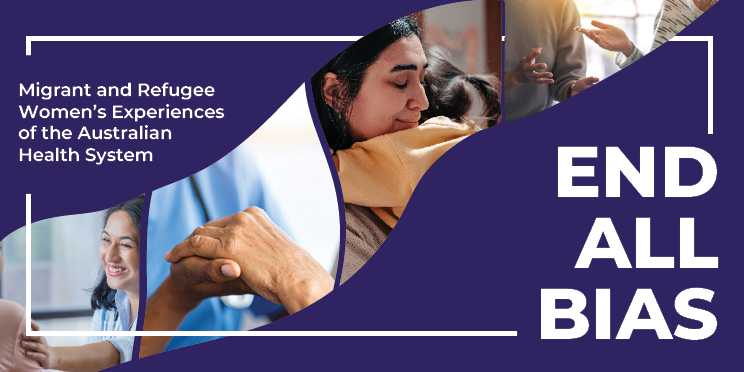
- End All Bias Research Project, funded by the Australian Government Department of Health and Aged Care.
- Perinatal Genomics Screening in partnership with the University of Melbourne (MRFF Grant)
- Arabic, Punjabi and Vietnamese women’s experiences of and access to contraception and women’s health care, in partnership with Jean Hailes.
- National Prevention of Gender Based Violence Guide in partnership with our Watch.
- Health Research for All in collaboration with Murdoch Children’s Research Institute.
- Giving Migrant Mums a Fair Go in partnership with Melbourne University.
- INCLUDE: Cervical Cancer Prevention for All in collaboration with the Kirby Institute.
- Sharing WISDOM in partnership with the University of Melbourne.
- Perinatal Mental Health Research in partnership with Monash university and funded by the Women’s Health Research Translation & Impact Network (WHRTN).
Read our updates Research and Advocacy Statement to learn more about our approach to research and key challenges that can arise for researchers in this field.
Please note, at this time we are unable to support or promote research projects in an unpaid capacity.
If you are interested in working or collaborating with MCWH in a funded research capacity please email rap@mcwh.com.au
Our approach to research
MCWH fosters an ethical and collaborative research culture that aims to achieve transformative change in immigrant and refugee women’s lives. Our approach to research:
- acknowledges and respects women’s experiences, values and knowledge;
- values and creates opportunities to draw on women’s knowledge and wisdom;
- promotes participatory processes;
- respects and acknowledges the cultural distinctiveness of, and inter-cultural differences between, immigrant and refugee communities; and
- fosters ethical and respectful relationships that affirm immigrant and refugee women’s right to have different values, norms and aspirations.
Our approach to immigrant women’s leadership in research
We regularly consult and work with immigrant and refugee women during the research process to ensure that:
- the research is both culturally appropriate and relevant;
- opportunities are provided whenever possible to develop immigrant women’s trust, agency and ownership over the research process;
- the research impacts and outcomes will be meaningful for women;
- respect for the dignity and wellbeing of participants takes precedence over the expected benefits to knowledge; and
- immigrant and refugee women will ultimately benefit from, and not be disadvantaged by, the research.
Our bilingual health education team plays a central role in working with women as peers and co-researchers in the collection and evaluation of data, and not as dispassionate researchers who are doing research about them.
Academic articles
2025
Altun, A., Oxlad, M., Hine, R., Reupert, A., Slewa-Younan, S., Ansari, D., ... & Boyle, J. A. (2025). “Lost in translation?”: A qualitative exploration of digital perinatal mental health resource use among migrant women. International Journal for Equity in Health, 24(1), 352. Link to publication.
Elliott, K., Block, K., Cho, H., & Murdolo, A. (2025). “It’s Really Important that we Listen to Them”: Engaging Immigrant Men in Family Violence Prevention. Journal of Family Violence, 1-13. Link to publication.
McKenzie, M., Medel, C. N., Tran, L. T., Forbes-Mewett, H., Murdolo, A., & Tarzia, L. (2025). A Shattered Dream: Women International Students’ Experiences of Intimate Partner and Sexual Violence in Australia. Journal of Family Violence, 1-12. Link to publication.
Tarzia, L., Navarro Medel, C., McLindon, E., Ezer, P., Forbes-Mewett, H., Tran, L. T., ... & Hegarty, K. (2025). Experiences of sexual and intimate partner violence among women international students in Australia. Violence Against Women, 10778012251323267. Link to publication.
Tran, G., Forbes-Mewett, H., Tran, L. T., Hach, M., & Tarzia, L. (2025). Help-seeking after intimate partner or sexual violence: exploring the experiences of international student women in Australia. Violence against women, 31(10), 2574-2602. Link to publication.
Vazquez Corona, M., Hazfiarini, A., Cao, J., Lees, R. A., Ansari, D., Tran, G., ... & Bohren, M. A. (2025). Migrant Mums and Maternity Care: A Qualitative Participatory Health Research Study. BJOG: An International Journal of Obstetrics & Gynaecology, 132(13), 2121-2130. Link to publication.
2024
Dawson, A. J., Heywood, A. E., Nathan, S., Mahimbo, A., Renzaho, A. M., Murdolo, A., ... & Hayen, A. (2024). Health of refugees settled in Australia over time and generations: a transformative mixed methods study protocol. BMJ open, 14(9), e083454. Link to publication.
2023
Sullivan, C., Block, K., Murray, L., Warr, D., Chen, J., Davis, E., ... & Vaughan, C. (2023). Working with interpreters in the family violence sector in Australia: “It's very hard to be in between”. International journal of intercultural relations, 96, 101871. Link to publication.
2022
Hourani, J., Jarallah, Y., Block, K., Murray, L., Chen, J., Hach, M., & Vaughan, C. (2022). How structural and symbolic violence during resettlement impacts the social and mental wellbeing of forced migrant women: the lived experiences of Arabic speaking survivors of IPV resettled in Melbourne, Australia. Conflict and health, 16(1), 59. Link to publication.
Sheeran, N., Vallury, K., Sharman, L. S., Corbin, B., Douglas, H., Bernardino, B., ... & Tarzia, L. (2022). Reproductive coercion and abuse among pregnancy counselling clients in Australia: trends and directions. Reproductive health, 19(1), 170. Link to publication.
Suha, M., Murray, L., Warr, D., Chen, J., Block, K., Murdolo, A., ... & Vaughan, C. (2022). Reproductive coercion as a form of family violence against immigrant and refugee women in Australia. PLoS One, 17(11), e0275809. Link to publication.
2020
Sullivan, C., Vaughan, C., & Wright, J. (2020). Migrant and refugee women’s mental health in Australia: a literature review. School of Population and Global Health, University of Melbourne: Melbourne, Australia. Link to publication.
Vaughan, C., Chen, J., Sullivan, C., Suha, M., Sandhu, M., Hourani, J., ... & Murdolo, A. (2020). Multicultural and settlement services supporting women experiencing violence: The MuSeS project. Australia’s National Research Organisation for Women’s Safety Limited (ANROWS). Link to publication.
2019
Vaughan, C., Jarallah, Y., Murdolo, A., Murray, L., Quiazon, R., Block, K., & Zannettino, L. (2019). The MuSeS project: a mixed methods study to increase understanding of the role of settlement and multicultural services in supporting migrant and refugee women experiencing violence in Australia. BMC international health and human rights, 19(1), 1. Link to publication.
Murray, L., Warr, D., Chen, J., Block, K., Murdolo, A., Quiazon, R., ... & Vaughan, C. (2019). Between ‘here’ and ‘there’: family violence against immigrant and refugee women in urban and rural Southern Australia. Gender, Place & Culture, 26(1), 91-110. Link to publication.
2018
Aryal, R. (2018). Enabling Social Change with Immigrant and Refugee Caregivers: Beyond Dualistic Difference to Intersectionality. American Anthropologist, 120(3), 551-554. Link to publication.
2016
Murdolo, A. (2016). Family violence in Victoria: A mainstream, multicultural response. Parity, 29(4), 36-37. Link to publication.
Murdolo, A., & Quiazon, R. (2016). Key issues in working with men from. White Ribbon Research Series. Link to publication.
Vaughan, C., Davis, E., Murdolo, A., Chen, J., Murray, L., Quiazon, R., ... & Warr, D. (2016). Promoting community-led responses to violence against immigrant and refugee women in metropolitan and regional Australia. The ASPIRE Project: Research report (ANROWS Horizons 07/2016). Link to publication.
2015
Murdolo, A., & Quiazon, R. (2015). 'Bringing the Margins to the Centre' in Our Watch, ANROWS and VicHealth. Change the Story: A shared framework for the primary prevention of violence against women and their children in Australia: Framework Foundations 2.
Vaughan, C., Murdolo, A., Murray, L., Davis, E., Chen, J., K., Block, K., … & Warr, D. (2015). ASPIRE: A multi-site community-based participatory research project to increase understanding of the dynamics of violence against immigrant and refugee women in Australia. BMC Public Health 15, 1283. Link to publication.
Vaughan, C., Murdolo, A., Davis, E., Warr, D., Quiazon, R., Block, K., ... & Chen, J. (2015). Promoting community-led responses to violence against immigrant and refugee women in metropolitan and regional Australia: The ASPIRE Project: State of knowledge paper. ANROWS Landscapes. Link to publication.
2013
Carolan-Olah, M. C., Cassar, A., Quiazon, R., & Lynch, S. (2013). Diabetes care and service access among elderly Vietnamese with type 2 diabetes. BMC health services research, 13(1), 447. Link to publication.
Poljski, C., Quiazon, R., & Tran, C. (2013). Ensuring rights: improving access to sexual and reproductive health services for female international students in Australia. Journal of International Students, 4, 150-163. Link to publication.
2011
Murdolo, A., & Poljski, C. (2011). On her way: Primary prevention of violence against immigrant and refugee women in Australia. Link to publication.
Recent Research News
End All Bias
Community Insights: COVID-19 response and recovery for older migrant and refugee women