End All Bias

This is a right for every human being living here…The basic healthcare system should be accessible to everyone, every migrant, either it’s a student, either it’s a skilled migrant, either it’s a student visa.” - End All Bias research participant
End All Bias is a national research project exploring how migrant and refugee women experience bias and discrimination within Australia's healthcare system.
Led by MCWH, the project builds on findings from the National Women's Health Advisory Council's #EndGenderBias survey, which highlighted the underrepresentation of migrant and refugee women's voices in research about healthcare experiences. End All Bias sought to address this gap by placing lived experience at the centre of the conversation.
Between June 2024 and June 2025, MCWH conducted focus groups in every state and territory with 139 migrant and refugee women from 22 countries of birth, representing a wide range of visa categories and residency statuses. Discussions were facilitated in participants' preferred languages by research-trained Bilingual Health Educators, creating safe and accessible spaces for women to share their experiences.
The result is one of the most comprehensive explorations of migrant and refugee women's experiences of healthcare bias in Australia to date, providing evidence for action at individual, organisational and systems levels.
Stories as evidence
A key strength of End All Bias was its intersectional feminist and community-led approach.
By conducting research in participants' preferred languages and working with trusted bilingual facilitators, the project enabled women to discuss personal experiences in ways that felt safe, respectful and accessible.
The findings demonstrate that the impacts of bias and discrimination extend beyond individual healthcare encounters. Participants described how it affected their physical and mental health, confidence in healthcare systems, willingness to seek care, and the wellbeing of their families and communities.
At the same time, women shared examples of what worked well for them in the healthcare system. Participants consistently described positive experiences when healthcare professionals listened without judgement, respected their autonomy, communicated clearly, acknowledged barriers to access and provided culturally and linguistically responsive care.
These experiences provide a roadmap for change, highlighting practical approaches that can help create more equitable healthcare systems.
“MCWH was the first ever organisation in Australia who cared and showed interest about migrant and refugee women’s health, knowledge, and well-being.” End All Bias research participant
Evidence into action
End All Bias transforms lived experience into evidence for change.
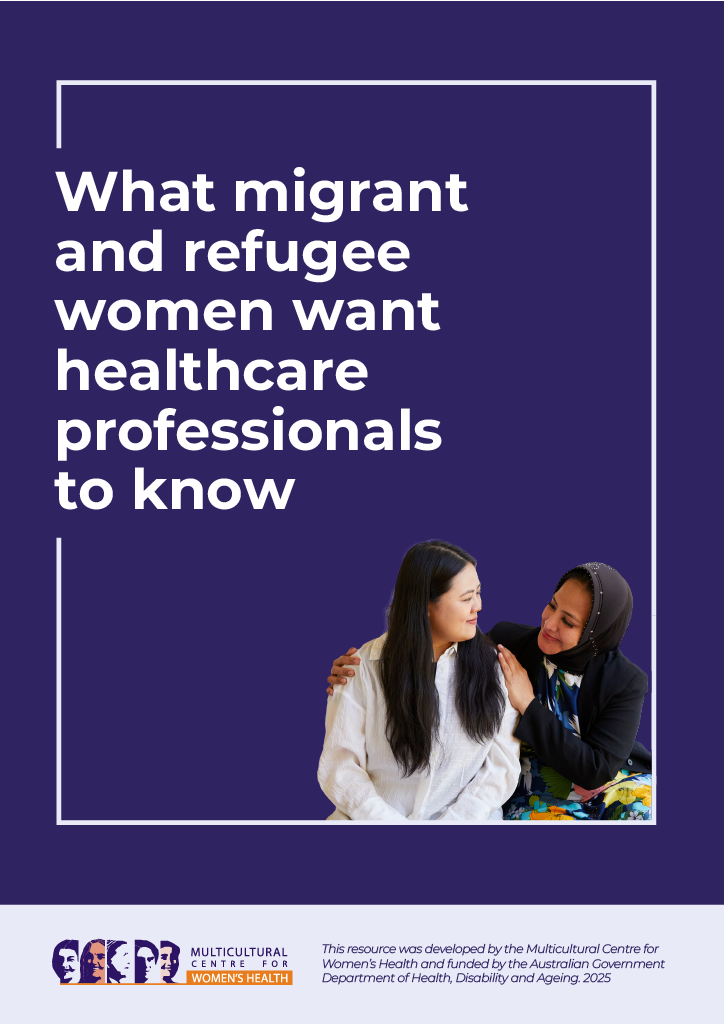
To support healthcare professionals and services to respond to these findings, MCWH developed What migrant and refugee women want healthcare professionals to know.
Drawing directly from the experiences shared by participants, the guide provides practical tips for healthcare practitioners, resources to share with patients and opportunities for services to strengthen culturally responsive practice.
The guide was featured as a digital resource at the national HealthEd conference, providing an opportunity for more than 1,800 healthcare professionals attending the conference to engage with the guide and its recommendations.